

Up to 30% of your digital marketing data is currently vanishing into thin air. Between ad blockers, aggressive browser privacy restrictions, and heavy browser-side tracking scripts, mid-market brands are operating with a massive blind spot.
Traditionally, web tracking has relied on the user’s browser (client-side) to send interaction data directly to platforms like Google Ads and Meta. But as modern browsers clamp down on privacy, this critical data stream gets blocked or severely degraded. The result? Your automated, AI-driven ad campaigns are forced to make optimization choices based on incomplete, inaccurate information.
By migrating your tracking infrastructure to Server-Side Google Tag Manager (GTM), you can bypass browser-level blocking, dramatically improve your website speed, and feed your ad platforms the pristine data they need to maximize your return on ad spend (ROAS).
What is Server-Side GTM? (And How It Solves the Data Gap)
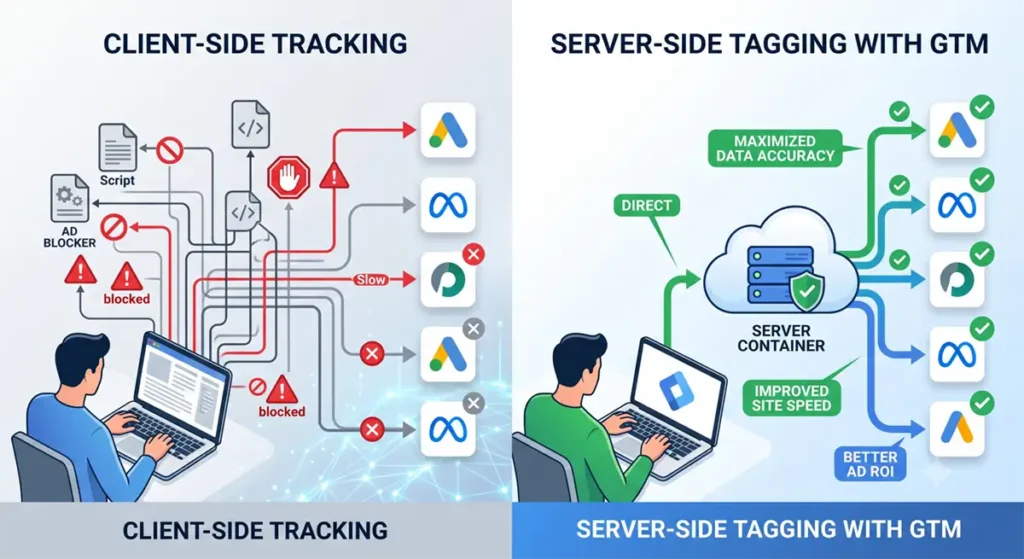
To understand why your current data is dropping off, you have to look at how the traditional web operates. In a standard client-side setup, your website’s browser loads dozens of individual JavaScript tags. Every time a user clicks or buys, those tags compete for browser processing power to talk directly to Google, Meta, TikTok, and your CRM.
Server-side tagging completely flips this dynamic. Instead of choking the user’s browser with a web of separate tracking scripts, the browser sends one single, clean stream of data to a cloud server that you own and control. That server then securely processes and distributes the data to your destination platforms.
[ Traditional Client-Side ]
Browser  --->  Google Ads
         --->  Meta Pixel
         --->  TikTok Pixel (Heavy browser bloat)
[ Modern Server-Side ]
Browser  --->  Your Secure Cloud Server  --->  Google, Meta, & CRM
Shifting this workload from the user’s device to a cloud container provides three immediate benefits:
Eliminate Browser Bloat: Removing heavy JavaScript execution times directly improves your Core Web Vitals. Faster load times keep users on the page, lowering bounce rates and naturally boosting organic conversion rates.
True First-Party Context: Because the data flows through a custom sub-domain tied to your brand (like
tracking.yourdomain.com), modern browsers treat it as secure first-party data rather than invasive third-party tracking.Total Control and Security: You act as the ultimate gatekeeper. Because the data hits your server first, you can scrub or redact sensitive personally identifiable information (PII) before it ever gets passed along to third-party ad networks.
Fueling AI Campaigns with Pristine Conversion Data
Modern digital advertising relies heavily on automated optimization. Tools like Google’s Performance Max and Meta’s Advantage+ Shopping campaigns require hyper-accurate, real-time conversion signals to know exactly which audiences to target. If your tracking framework misses a conversion, the AI’s optimization loop breaks, and your budget is spent chasing the wrong profiles.
Implementing server-side tracking directly repairs this performance loop in three key ways:
1. Seamless Enhanced Conversions Integration
Server-Side GTM acts as a secure, direct pipeline for features like Google’s Enhanced Conversions. It allows you to securely hash user identifiers (like email addresses) server-side, matching them perfectly back to Google accounts without exposing raw user data in the browser source code.
2. Bypassing Ad-Blocker Drop-Off
Standard ad blockers look for known client-side scripts firing in the browser. When they find them, they shut down the request. Server-to-server calls bypass this entirely because the purchase data is sent directly from your cloud server to the ad platform’s endpoint. Legitimate conversion actions are always recorded.
3. Fighting Back Against Extended Cookie Decay
Apple’s Intelligent Tracking Prevention (ITP) and similar browser initiatives regularly cut the lifespan of standard client-side cookies down to a window of 1 to 7 days. If a customer takes 8 days to buy after clicking an ad, your platform loses the attribution link. Server-set first-party cookies keep your attribution windows intact, which is vital for complex mid-market sales cycles.
The Roadmap to Implementation for Non-Enterprise Brands
Many business owners assume that server-side tagging is a luxury reserved for enterprise companies backed by dedicated DevOps teams. It does require technical precision, but mid-market brands can successfully transition using a structured, four-step approach.
Provision a Cloud Container:
Step 1
Set up a dedicated server container. You can provision this directly through Google Cloud Platform (GCP) or utilize a specialized analytics hosting environment like Stape.io to simplify infrastructure management.
Map Your Custom Sub-domain:
Step 2
Create a new routing path in your company’s DNS records (e.g., pointing metrics.yourcompany.com to your new cloud server). This step is what establishes the crucial first-party relationship that protects your data from browser blocks.
Consolidate Client-Side Tags:
Step 3
Transition your primary Google Analytics 4 (GA4) setup to act as the primary “client.” Instead of running separate tags for every network, your web layer sends data once to your server container, which routes it outward.
Audit and Validate:
Step 4
Run parallel tracking configurations. Compare the raw data hitting your old client-side tags against your server-side stream to calculate the exact lift in recorded conversions and identify any missing gaps.
The Gravitate One Advantage
Moving your tracking architecture server-side shifts your marketing infrastructure from routine tag management into true cloud data engineering and DNS coordination. A single misconfigured parameter can accidentally break your conversion tracking entirely, leaving your ad campaigns flying blind.
At Gravitate One, our technical analytics specialists design and deploy customized server-side tracking environments tailored to your brand’s unique software stack. We handle the complexities of cloud container setup, manage secure server-to-server data pipelines, and lay down a resilient first-party data framework.
We manage the technical data engineering so your internal marketing teams can focus on running high-impact campaigns backed by the cleanest, most complete attribution data possible.
Conclusion
Relying on the user’s browser to accurately report conversion events is an outdated strategy in today’s privacy-centric digital ecosystem. Transitioning to a Server-Side GTM strategy is the definitive solution to browser data loss—simultaneously speeding up your site, protecting consumer data privacy, and giving your automated ad campaigns the high-fidelity data they need to outperform the competition.
Ready to reclaim your lost conversion data? Contact Gravitate One today for a Technical Tracking Consultation, and let’s unlock the true conversion potential of your ad spend.